



For many employees, alcohol use happens outside of work. The impact doesn’t stay there.
Most employers are not looking for an alcohol problem. They are looking at attendance records, performance reviews, and engagement scores, and seeing something they cannot quite name. As long as it is not happening at work or creating a direct liability, it is not really their concern. Right?
Wrong.
What employees carry into work on a Monday morning does not leave itself at the door. Alcohol use that happens in personal time, to decompress, to cope, to get through, shapes how people sleep, how they regulate their emotions, and how they show up the next day. Over time, it drives increased rates of anxiety and depression, disrupted sleep, and a range of physical health conditions that quietly inflate healthcare costs in ways that never get traced back to their source. The claim does not say alcohol. But the pattern is there.
“Over time, it drives increased rates of anxiety and depression, disrupted sleep, and a range of physical health conditions that quietly inflate healthcare costs in ways that never get traced back to their source. The claim does not say alcohol. But the pattern is there.”
Productivity culture has a shadow side. In many workplaces, the drive to stay busy, keep moving, and push through is not just normalized. It is rewarded. For employees navigating a complicated relationship with substances, that same high-speed momentum can quietly deepen the problem.
The pattern is more common than most benefits leaders realize. Employees who struggle with substance use are not always the ones who appear to be falling apart. They are often the ones who appear to be holding everything together. The busyness, the constant productivity, the drive to “do better and move faster” can function as a coping strategy that masks what is going on beneath the surface. Until it doesn’t.
The workforce cost is not hypothetical. According to the National Council on Alcoholism and Drug Dependence, substance use costs U.S. employers upwards of $81 billion each year. Alcohol is a significant driver of that figure, and yet it remains one of the most underaddressed areas in workplace benefits. Not because employers do not care, but because the employees who need substance use health support most are often the least visible ones.
Mindfulness and alcohol use
We spoke with Brianne Flaherty, one of more than 500 leading LifeSpeak experts, to understand what is driving that cycle and what it takes to interrupt it. Brianne is a Certified Canadian Addiction Counsellor, Master Practitioner in Clinical Counselling – Provisional, and Certified Clinical Trauma Professional who works one-on-one with members and their family members navigating substance use and behavior change. Across her library of member resources on the LifeSpeak platform, she offers practical, immediately usable tools for slowing down, managing cravings, and building a different relationship with alcohol. Her resource Slowing Down to Go Fast: A Mindfulness Approach to Substance Use Health is a strong starting point for members ready to explore what that looks like in practice.
“Employees who struggle with substance use are not always the ones who appear to be falling apart. They are often the ones who appear to be holding everything together. The busyness, the constant productivity, the drive to “do better and move faster” can function as a coping strategy that masks what is going on beneath the surface. Until it doesn’t.”
When busyness and alcohol use go hand in hand
In Brianne’s practice, a pattern emerges consistently. Employees trying to change their relationship with alcohol often respond by filling their schedules, setting ambitious goals, and staying in motion. On the surface, it looks like progress. In her experience, it often is not.
“The busyness, planning, and doing is often a coping strategy,” Brianne explains. “It takes them away from the pain they’re carrying, which leaves them feeling worse. Whether someone is drinking or running a 5k sprint, they’re moving away from their emotional experience.”
The mechanism is the same whether the outlet is alcohol or a packed calendar: avoidance of the underlying emotional experience. Redirecting the coping strategy does not resolve the trigger. It delays it. And without the right support, the cycle continues, building cost in ways that rarely surface until the situation is already serious.
This is where mindfulness enters the picture. Not as an afterthought, but as a mechanism for lasting change.
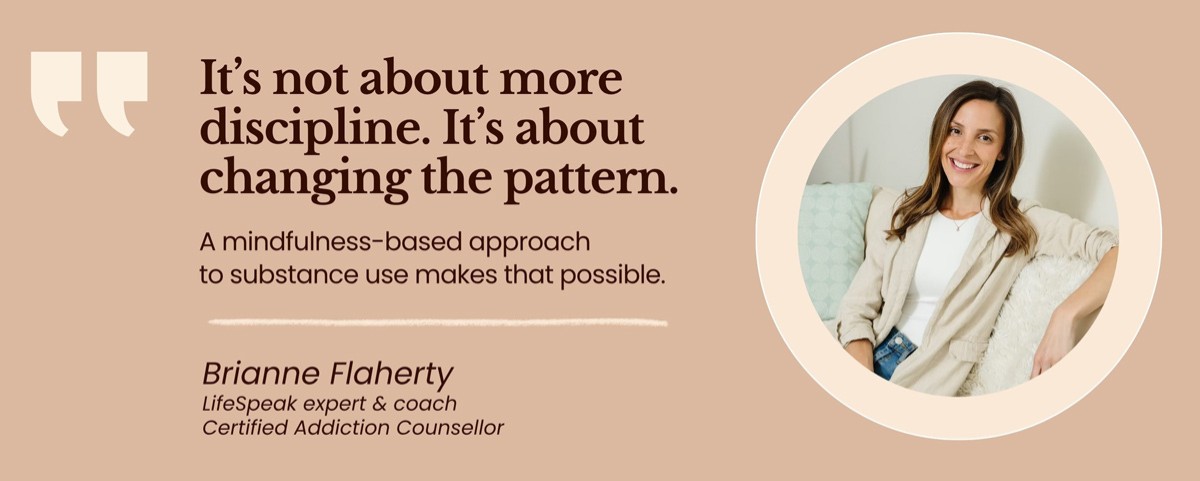
What mindfulness means in a substance use context
When it comes to substance use, mindfulness is not about meditation apps or breathing exercises, though those can play a role. It is about developing the capacity to feel a difficult emotion without immediately escaping it. To notice the urge to drink, and stay present with what is underneath it, long enough for that urge to lose its grip.
Brianne describes it as learning to be with yourself rather than running from yourself. For many people navigating a complicated relationship with alcohol, those two things have become indistinguishable.
The mechanism behind this is cognitive flexibility: the ability to shift out of a fixed, reactive state of thinking into a more adaptive one. When cognitive flexibility is low, cravings intensify, triggers feel unmanageable, and the path back to alcohol feels shorter than the path through the discomfort. Mindfulness widens that gap.
Brianne identifies four specific ways this shows up in practice:
- Trigger identification. Slowing down long enough to notice what precedes the urge to drink. Once triggers are visible, they can be planned around rather than stumbled into.
- Craving reduction. Cravings are driven by fixed, substance-focused thinking. Mindfulness interrupts that loop and brings attention back to the present moment, reducing the intensity of the urge before it becomes a decision.
- Emotion regulation. The inability to sit with distressing emotions is frequently what drives use. Mindfulness reduces the intensity of that distress and supports faster emotional recovery, making the next difficult moment more manageable than the last.
- Self-awareness. Reconnecting to personal values and goals builds the internal motivation that sustains behavior change over time. This is what makes change last beyond the initial effort.
These are evidence-based outcomes. They are also workforce outcomes. Employees who can regulate their emotions, manage triggers, and stay present are more engaged, more consistent, and less likely to reach a point that costs the people and the organization around them.
“Brianne describes it as learning to be with yourself rather than running from yourself. For many people navigating a complicated relationship with alcohol, those two things have become indistinguishable.”
What this means for benefits leaders
Alcohol use rarely announces itself in the workforce. It accumulates in declining engagement, increased absenteeism, and healthcare claims that do not point to an obvious cause. By the time the pattern is visible, the cost has been building for some time.
Early, accessible, and confidential support changes the outcome. It does not rely on a performance issue to force the conversation or require an employee to disclose to their manager or navigate a referral process. It makes help available before the situation reaches a threshold that affects the people around them.
LifeSpeak members seeking support for substance use consistently report meaningful improvements. 79% reduce their use by an average of 2.2 units per day, 77% report better functioning at work and at home, and 79% report improved mental health.
The employees most at risk are not waiting for an employer program to tell them they have a problem. Many already know. What they need is a way to access support without having to raise their hand or disclose their situation at work.
By adding LifeSpeak’s substance use support for employees and their family members, you create that path. Individuals can access confidential, evidence-based programs, connect with experienced coaches like Brianne, and explore self-guided tools grounded in mindfulness and behavior change, all on their own terms. No referral required. No barriers between the moment someone is ready and the help they need.
If you are exploring ways to better support your population, learn more about our substance use solution or get in touch to start a conversation.
Frequently asked questions
What is the connection between mindfulness and alcohol use?
Mindfulness supports behavior change by building cognitive flexibility, improving emotion regulation, and increasing present-moment awareness. These capacities reduce cravings, help employees identify and manage triggers, and support the kind of sustained change that willpower alone cannot produce.
Why do high-functioning employees often go unnoticed when struggling with alcohol?
Employees who use alcohol as a coping strategy are often high-output and visibly engaged at work. The busyness and productivity that mask the pattern can look like strength from the outside. This is one reason alcohol-related issues are underreported and underaddressed in workplace benefits programs.
How does alcohol use outside of work affect workplace performance and health costs?
Alcohol use that happens in personal time affects how employees sleep, manage stress, and regulate their emotions. Over time it contributes to increased rates of anxiety, depression, and physical health conditions that drive up healthcare utilization and absenteeism in ways that rarely get identified as alcohol-related on a benefits report.
What does confidential substance use support look like in a workplace context?
Confidential support means employees can access coaching, programs, and resources without involving their manager, HR department, or employer. LifeSpeak’s Substance Use Health track is accessible without a referral and available to both employees and their family members.
Why do traditional EAPs often fall short on alcohol and substance use support?
Traditional EAPs typically offer a limited number of sessions and rely on the employee to self-identify and initiate contact. Utilization rates average 3 to 5 percent. For a workforce issue as stigmatized and underreported as alcohol use, that access model leaves most of the risk unaddressed.
Can family members access substance use support through LifeSpeak?
Yes. LifeSpeak extends support to employees and their family members. This is particularly relevant for alcohol use, where family members are often significantly affected and where family engagement can play a meaningful role in the employee’s own behavior change.